Theme for Open Access Week 2026 is “The Cost of Knowledge”
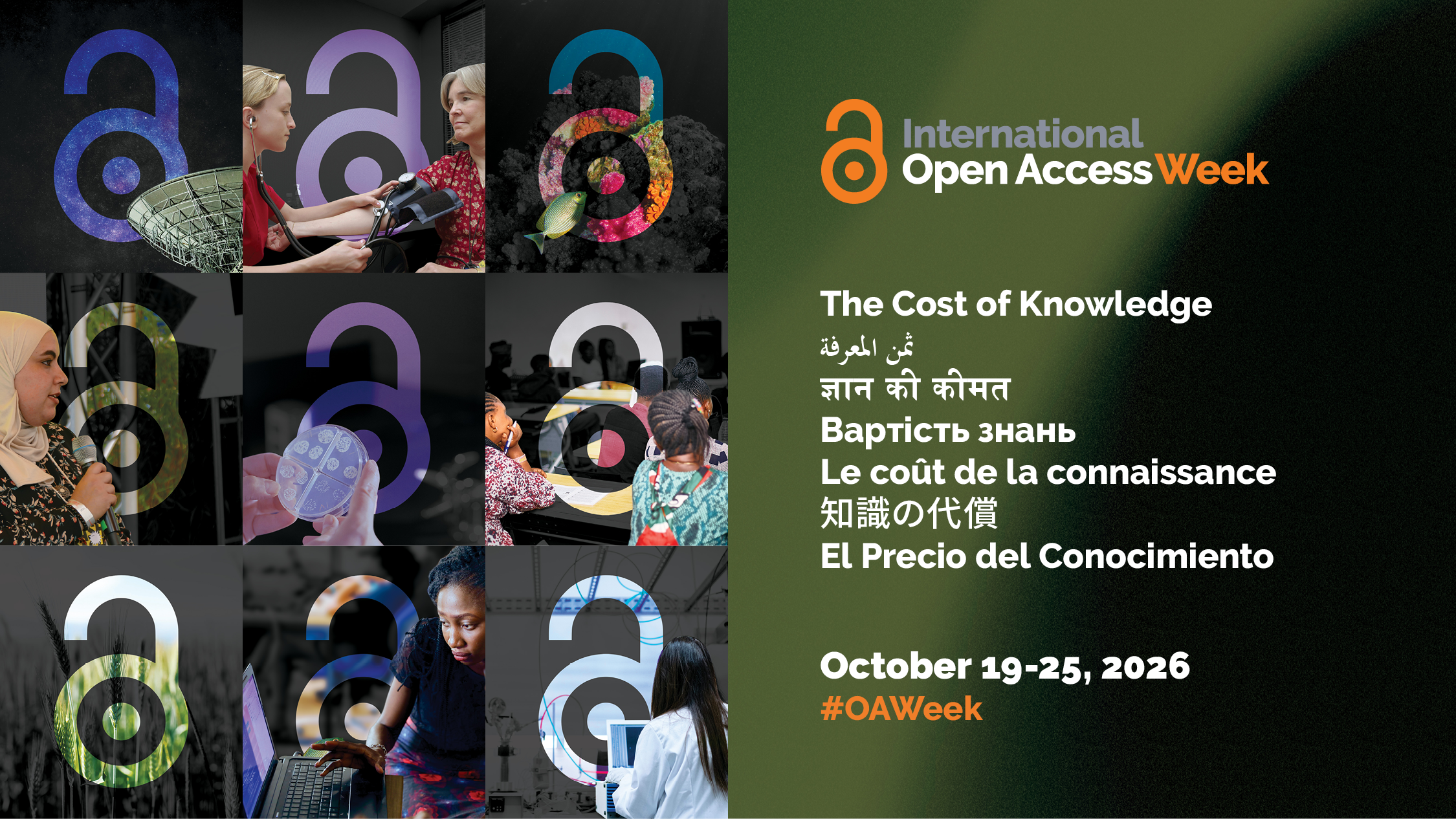
“The Cost of Knowledge” is the theme for this year’s International Open Access Week (October 19-25).
We create and share knowledge in order to advance human understanding and the common good. We recognize that accessing and sharing knowledge is a human right. Yet, the costs to access and share knowledge continue to increase, often dramatically. Why? Who benefits?
Increasing consolidation and commercial control over all aspects of knowledge comes at a cost. This year’s theme challenges us to consider the financial, human, and environmental costs of creating, sharing, and sustaining knowledge—particularly when these costs are driven by private rather than public interests. Last year’s theme of “Who owns our knowledge?” reflected on the reality of commercial ownership of knowledge. This year’s theme will reckon with the costs of that reality and avenues for reclaiming control of these systems meant to serve the public interest.
These costs go well beyond the rapidly inflating price of journal subscriptions and article processing charges. What is the value of the time and effort invested by authors, reviewers, and editors in publications, and whose interests does this uncompensated labor serve? What is the cost of excluding much of the world’s population from equitable participation in producing, sharing, and sustaining their knowledge or of failing to recognize Indigenous Data Sovereignty? Why are researchers’ works being licensed for proprietary AI training without consent or compensation, and why do platforms for sharing knowledge now frequently surveil users? What is the cost of prioritizing data centers over people’s needs for power and water?
The status quo is not equitable. It never has been, and maintaining it is not neutral. Building systems for sharing knowledge that reflect the best interests of the communities they serve requires a commitment to these systems, individually and collectively.
Fortunately, there are many examples for how we can create, sustain, and share knowledge as a public good. From Indigenous Data Governance models to no-fee, non-commercial, and community-driven sustainability models for publishing, momentum is growing for approaches that treat knowledge as a common good and not a commodity to be mined. The importance of these approaches has been recognized by 193 countries in adopting the UNESCO Recommendation on Open Science. International Open Access Week is a time to move beyond conversations and catalyze change toward ways of sharing knowledge that honor the reasons we create knowledge in the first place.
Open Access Week 2026 will be held from October 19th through the 25th; however, anyone is encouraged to host discussions and take action whenever is most suitable during the year. Communities can adapt the theme to their local context and focus on specific conversations that are most meaningful. Customizable graphics templates are available to promote these locally adapted themes.
Translations of this announcement in other languages, graphics for this year’s theme, and more information about the week are available at openaccessweek.org. The official hashtag for the week is #OAWeek.
About SPARC
SPARC is a non-profit organization that supports open systems for research and education that enable everyone, everywhere to access, contribute to, and benefit from the knowledge that shapes our world. International Open Access Week was established by SPARC and partners in the student community in 2008. Learn more at sparcopen.org.
About International Open Access Week
Open Access Week is an invaluable chance to connect the global momentum toward the open sharing of knowledge with the advancement of policy changes and the importance of social issues affecting people around the world. The event is celebrated by individuals, institutions, and organizations around the world, and its organization is led by a global advisory committee, which selects each year’s theme. The official hashtag of Open Access Week is #OAweek.
