
arXiv
Background: Founded in 1991, arXiv was a pioneer in the open science movement by making it easy to share preprints all over the world quickly and freely. Originally developed at Los Alamos National Laboratory, arXiv moved to Cornell University in 2001. After 25 years of collaboration and growth at Cornell, arXiv was established as an independent, nonprofit organization in July 2026. Now, the open research-sharing platform has more than 3 million scholarly articles in physics, mathematics, computer science, quantitative biology, quantitative finance, statistics, electrical engineering and systems science, and economics. arXiv is a curated repository and relies on a community of nearly 300 volunteer moderators, along with ~25 staff members.
Mission: arXiv’s mission is to enable the advancement of science by making research easily accessible to all. The open infrastructure allows researchers to share and discover new, relevant, emerging science and establish their contribution to advancing research. Its vision is for all researchers around the world to have immediate, free and open access to all established and emerging research in their field.
The Cost of Knowledge
“The idea for arXiv was borne out of a discussion several researchers were having and the feeling of community grew from there. Researchers saw the value and became involved as volunteers to help contribute and moderate the preprints. At first, it seemed like a very simple solution to solve a problem in a pragmatic way. Now, 35 years later, it's one of the most persistent, largest communities around open access and open infrastructure.”
“The period that we're in with AI is creating opportunity but also strain on some of these open infrastructure and open communities. It’s accelerating the process of being able to write and submit papers and conduct research. That's bringing a lot of the cost of operations into sharp relief. arXiv is sitting at the center of a lot of these questions.”
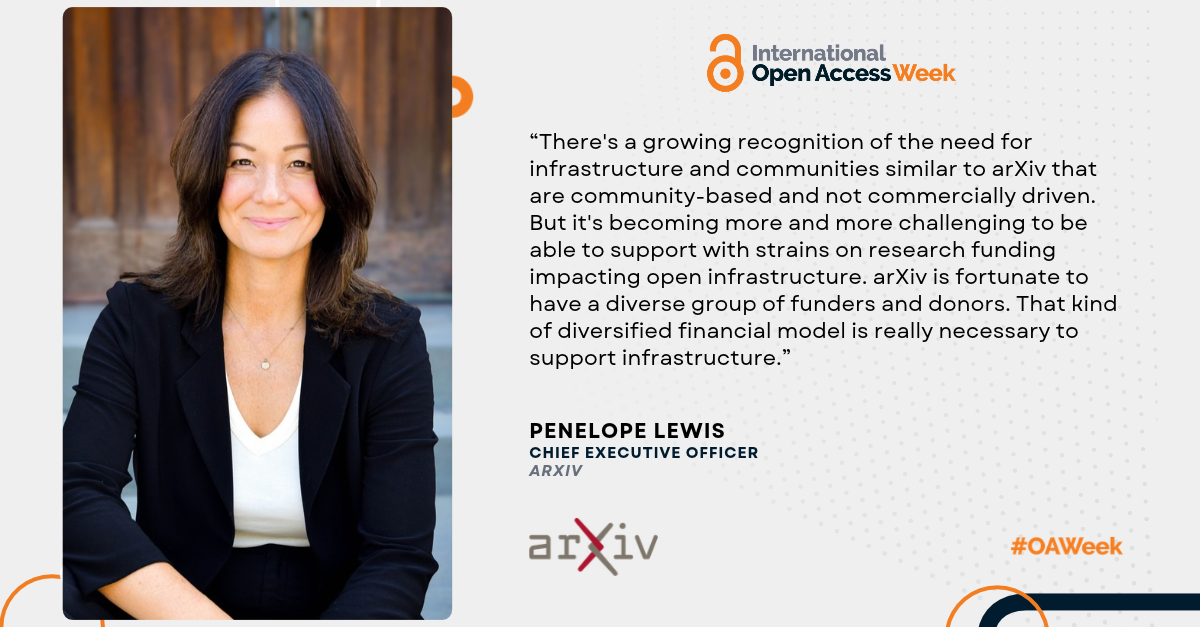
“There's a growing recognition of the need for infrastructure and communities similar to arXiv that are community-based and not commercially driven. But it's becoming more and more challenging to be able to support with strains on research funding impacting open infrastructure. arXiv is fortunate to have a diverse group of funders and donors. That kind of diversified financial model is really necessary to support infrastructure.”
“With community-based infrastructure, cost doesn't always mean financial cost - it can also be paid in time, dedication, and shared responsibility. arXiv has a very passionate, dedicated community of volunteers who are researchers themselves and play a critical role in moderating and validating arXiv’s preprints. The willingness is there because they see the value and benefit that arXiv provides, but it’s getting harder as demands on researchers’ time keep growing. It’s an important hidden cost that doesn’t necessarily show up in a budget, but is critical to sustaining a service like arXiv.”
-Penelope Lewis, Chief Executive Officer, arXiv