Open Journals Collective
Background: The Open Journals Collective (OJC) is an international collective of scholars, libraries, university presses, and non-profit academic publishers. OJC’s members believe that academic research should be available to all, with no author fees and no paywalls. OJC was incorporated as a community interest company in the United Kingdom in 2025 and officially launched in January 2026. The organisation is in the process of establishing a charity, the Open Journals Collective Foundation, which will oversee its activities from January 2027 onwards.
OJC is designed to raise collective investment for a transition to academic-led, non-profit diamond open access. Operated by a network of around 50 volunteers and managed by a small team of three members of staff (with a fourth joining soon), it currently has 278 titles in its launch catalogue. Libraries can choose to invest in one of OJC’s three collections, and membership benefits include participation in OJC’s community governance model. This gives libraries control over how their investment is spent. Library representatives can join working groups and committees to contribute to a range of organisational activities, including: managing journal applications, making decisions on disseminating funds for journals, advising on metadata refinement projects, and overseeing financial reporting to build transparency and accountability.
The project started in Fall 2024, when Professor Caroline Edwards realised that libraries and non-profit publishers needed to work together at scale to improve the visibility and sustainability of community-led journals. Caroline drew on her experience running the Open Library of Humanities (OLH) at Birkbeck, University of London, a diamond open-access publisher that she co-founded with Professor Martin Eve in 2013. OLH publishes humanities and social sciences journals and has achieved some high-profile “flips” away from commercial publishers like Elsevier, Taylor & Francis, Wiley, and Springer Nature. OLH has 41 journals in its portfolio and is one of 28 publishing members of the OJC.
Mission: The mission of OJC is to build a sustainable future for academic journals by challenging the profit-making models of global corporate publishing and data systems.
The Cost of Knowledge
“I'm a literature scholar and my research focuses on science fiction and the utopian imagination. I'm constantly working with texts that try to reimagine how we could create a more just society and world. I'm starting to think those skills have helped me in my publishing journey in a way that I hadn't really appreciated before.”
“I describe myself as an angry academic. From early in my career, it became clear to me that my research is treated with little respect by commercial publishers who are only interested in profit margins. Many academics don't quite appreciate the impact of their decisions of where to publish and how this affects library budgets at their university. If I choose to publish with the so-called “big five” commercial publishers this puts pressure on my library to sign a prohibitively expensive Transformative Agreement (TA). These TAs can cost up to two thirds of an entire university library budget, meaning cuts must be made elsewhere and the library’s ability to support students, purchase books and other materials, or retain its own staff is reduced.
“I come from a DIY activist background. Lots of academics just start publishing their own work without particularly understanding the value-adds that publishers bring. It got me thinking: What is the actual cost of publishing? If all of us are doing this uncompensated labor, where is the money going? I started to realize you can publish at a professional standard relatively cheaply with a non-profit, open-access model.”
“Where are those extra costs? Why are they so hidden? It makes me absolutely furious. Because when you aggregate these costs, we've got an industrial-scale extraction taking place, siphoning university funding into global publishing companies. At this point, we can’t really call them publishers in the traditional sense. They're basically data mining and data analytics companies. They are selling enormous bundles of our research data to the large language models and the AI companies to generate profit for their shareholders.”
“That acquisitive principle of extracting as much surplus value as possible is absolutely at odds with the public good and our mission as university professionals. As taxpayers, we've already paid for that knowledge through research funding and researchers’ salaries, and charity-funded research has been paid for by supporters as well. There's absolutely no ethical justification for that knowledge being paywalled and sold back as a product to the universities.”
“I feel positive about progress being made in the open access community. When we were launching the Open Journals Collective, we weren’t quite sure how our fundraising campaign would go. In the U.K., the higher education sector is chronically under-funded and is now entering an accelerated phase of contraction as universities close programmes, sell off campuses, and implement debt reduction processes that involve large-scale redundancies of academic and professional services staff. Despite all this, many libraries joined OJC in 2026 to support our work to scale investment in diamond open access journals as a credible alternative to commercial Transformative Agreements. We are making progress.”
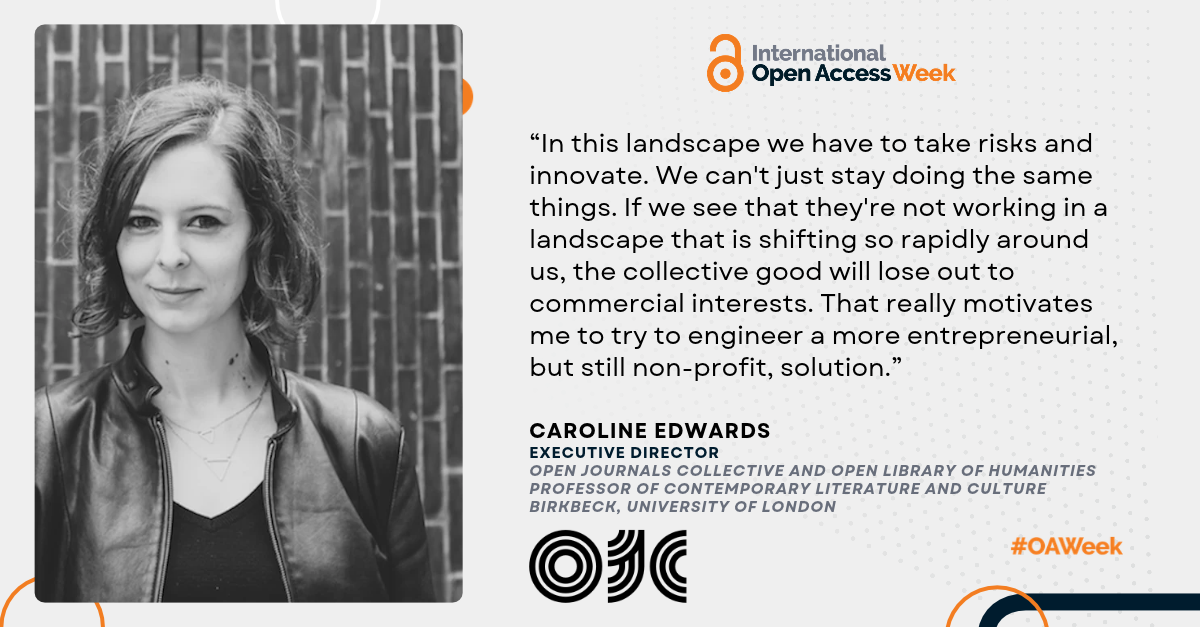
“In this landscape we have to take risks and innovate. We can't just stay doing the same things. If we see that they're not working in a landscape that is shifting so rapidly around us, the collective good will lose out to commercial interests. That really motivates me to try to engineer a more entrepreneurial, but still non-profit, solution.”
-Caroline Edwards, Executive Director, Open Journals Collective and Open Library of Humanities, and Professor of Contemporary Literature and Culture at Birkbeck, University of London