
Lyrasis Open Access Community Investment Program (OACIP)
Background: In 2020, Lyrasis, a nonprofit membership organization serving libraries and other cultural and knowledge organizations, established the Open Access Community Investment Program (OACIP) to create a shared approach to understanding, evaluating, and supporting diamond open access journals. OACIP brings together libraries, academic departments, research centers, funding agencies, and other organizations to invest in participating journals. By making journal practices, operations, and funding needs more visible, OACIP empowers organizations to make informed decisions about how they support scholarly publishing and fosters shared learning opportunities.
Mission: OACIP enables communities to collectively sustain diamond open access journals. Its approach is guided by five principles: sustainability, principle alignment, inclusion, collaboration, and efficiency. Rather than treating funding as an end in itself, OACIP develops a clearer understanding of what journals need to operate effectively and provides a mechanism for communities to share responsibility for those needs. The resulting relationships and evidence can strengthen individual journals while generating broader knowledge about the resources, practices, and conditions that support resilient diamond open access publishing.
Journal spotlight: Canadian Journal of Bioethics/Revue Canadienne de Bioéthique (CJB/RCB) (formerly BioéthiqueOnline, 2012-17). This bilingual, diamond open access journal was part of the fourth OACIP cohort and was partially funded for the 2024-2026 OACIP term. It will soon be renewing as part of the 2027-2029 cohort, which will launch in late October.
The Cost of Knowledge
“The traditional journals were produced by academic societies and knowledge was supposed to circulate - based on a bunch of old men who had enough money to pay for their own science. Fast forward to the 21st century, everything got bought up by the Big Five academic publishers. They are making billions of dollars in profit. And, now we're paying for it. We're paying for it with our subscriptions, when we pay for open access, with all the free labor that we do as an academic community to support peer review and editorial work. There’s a cost to that...It’s unfair and it’s unsustainable.”
“You want that quality control, and that's supposed to be what peer review is about. It's less and less functional. It's something that we have to rethink. There are discussions about open peer review. Ultimately, what we want is information and knowledge to circulate. But how do you translate information into knowledge? That's where research comes in, but you also need external critiques. This is something that we're now experimenting with.”
“We're starting to see interesting discussions happening in the university community. We've got to find other ways to finance journals if we want to keep them accessible. If we want knowledge to circulate, that means they need to be open access. It can't be hidden behind paywalls. It can't be pay-to-publish – because it’s a barrier and it opens up to all the predatory journals. In many domains, particularly in the humanities and social sciences, there's zero culture of pay-to-publish so people immediately think it's a scam. Whereas in the fundamental and applied sciences, they're used to it because they have bigger budgets.”
“If we want knowledge to circulate, we've got to support the vehicles in which knowledge can circulate. The cost barriers have come down incredibly. When you eliminate publication charges, when you eliminate printing, that saves a huge amount of money. But it still takes salaries of a couple of people to keep a journal functional, even if you're not at the level of the commercial presses.”
“We're in a world where information circulates freely, where we no longer pay for newspapers. We read it online, so we see it’s free – but someone is paying for it. We're paying for it with our data. We're paying for it in different ways with infrastructure and control of our media. In an academic research space, someone's got to make it available, and that requires researchers. Part of that is paid for by universities, and largely their budgets come from governments and student enrollment.”
“It’s important for universities to reclaim the role of knowledge experts and as institutions that are trustworthy to be sources of reliable knowledge. Our challenge now is that we live in a world where knowledge, in its pure sense, is harder and harder to differentiate from information of variable quality. If we want universities to retain their privileged status as generators of knowledge that is worthy of trust, and we want our public to have access to that – whether it's, you know, our fellow citizens or decision makers – universities have a privileged position to become the anchor for that.”
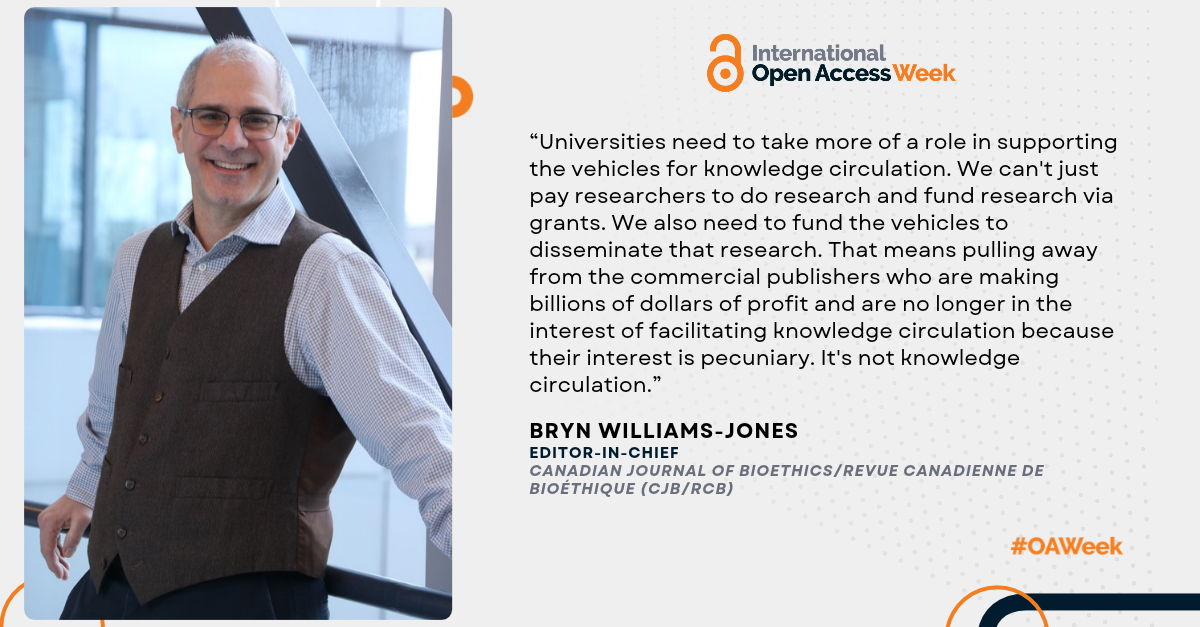
“Universities need to take more of a role in supporting the vehicles for knowledge circulation. We can't just pay researchers to do research and fund research via grants. We also need to fund the vehicles to disseminate that research. That means pulling away from the commercial publishers who are making billions of dollars of profit and are no longer in the interest of facilitating knowledge circulation because their interest is pecuniary. It's not knowledge circulation.”
-Bryn Williams-Jones, editor-in-chief of Canadian Journal of Bioethics/Revue Canadienne de Bioéthique (CJB/RCB).