OpenAlex
Background: OpenAlex is a nonprofit that builds open infrastructure for research information. Founded in 2012 (originally as ImpactStory), the organization also created and operates Unpaywall and Unsub. Its flagship database, also called OpenAlex, launched in 2022 as a free and open catalog of the world's scholarly papers, researchers, journals, institutions, and funders, along with all the ways they're connected. It currently stores one-half billion works, has 200,000 unique users on the website, and responds to 1.5 billion requests calls a month.
Mission: OpenAlex is a free and open catalog of the world's research system. Its mission is to make all of it available to everyone, everywhere. It gathers research metadata from thousands of sources, links it together, and releases it as open data with no restrictions on reuse.
The Cost of Knowledge
“We have a staff T-shirt that says in ancient Greek: ‘Knowledge wants to be free.’ The end of that quote is, ‘But it's just too valuable.’ The narrative in the research information space now is ‘Metadata is the new oil.’ Commercial publishers have realized universities don't necessarily need all the content. They just need to know what their researchers are publishing. They clued in on this idea that it's incredibly valuable if you can hoard all of this metadata and then sell trickled access to it.”
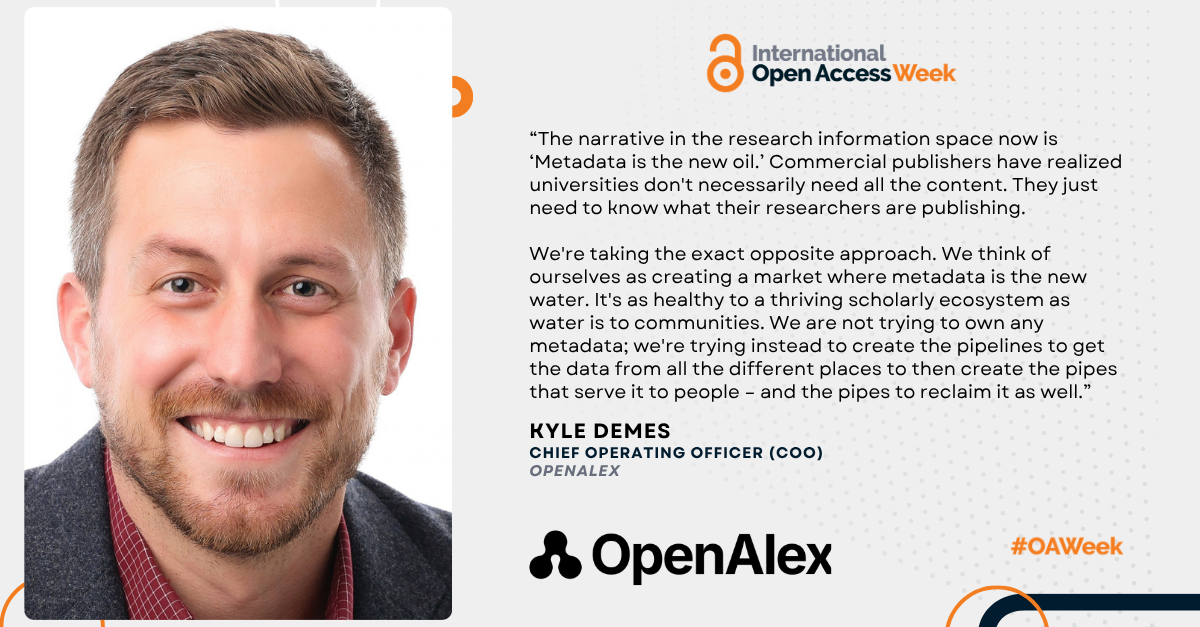
“We're taking the exact opposite approach. We think of ourselves as creating a market where metadata is the new water. It's as healthy to a thriving scholarly ecosystem as water is to communities. We are not trying to own any metadata; we're trying instead to create the pipelines to get the data from all the different places to then create the pipes that serve it to people – and the pipes to reclaim it as well.”
“We don't want innovation in this space to be throttled by lack of access to the data. We're going to worry about building these pipes, and we want it to be used by everyone. As long as people are charging for data, it always has that same smell to it.”
“Economics are driving libraries to reevaluate how much they can spend. While a lot of people have believed in principles of open science for a long time, they haven't really been able to make the headway because there hasn't been an imperative for the organizations, for libraries. Right now, there's an imperative.”
“This is creating almost a perfect alignment or constellation of events to equip libraries to start doing really great, value-add work with open data. They're making decisions to keep their staff while getting rid of some of the proprietary databases. That means now we have essentially an army of people around the world who are prepared and ready to really advance open science because that's right now that would be the only way some of them can do it.”
“We're trying to help the public cash some of the checks that the research community has been writing to society for a long time. There's been this growing tension between academic organizations having more and more resources, but feeling further and further removed from other parts of society. People have talked about the ivory tower forever, but it feels more acute now than ever. We’re starting to see a loss of public trust in institutions.”
“Now we're at a point where we can put all the world's research information into a single place and build that connective tissue around it to start unlocking these solutions that we already have – that are being stifled by silos,”
“We have the tools to build one big database with all the connective tissue. We're trying to cash that check so that research can advance and better people's lives faster.”
-Kyle Demes, OpenAlex