
Imaging Neuroscience
Background: Imaging Neuroscience is an open access non-profit journal published by MIT Press. It covers research on brain function, structure, and behavior through the application of neuroimaging, as well as major advances in brain imaging methods. The journal began after more than 40 editors of Elsevier’s NeuroImage resigned in April 2023 over issues of unsustainable article processing costs. The independent OA journal produced its first issue in May 2023.
The Imaging Neuroscience editorial team values equity, diversity and inclusion. By significantly cutting the cost of APCs, the journal has opened the opportunity to publish to a wider array of voices including junior scholars.
Citations of Imaging Neuroscience already outpace those of its predecessor. While Impact Factor is a problematic indicator for assessing individual works, the new journal notes that it is projected to exceed Elsevier’s NeuroImage in this metric in 2027, highlighting the extent to which Imaging Neuroscience has taken over the old journal’s role in the community it serves.
The Cost of Knowledge
“Since launching Imaging Neuroscience, we have increased the number of submissions to the journal and popularity is holding steady. We received 500 submissions in 2023; 878 in 2024; 865 in 2025, and as of mid May 2026 we had received 425 submissions with a projection of more than 1,000 total for 2026. The number of published articles has also grown from 50 in 2023 to 440 in 2025.”
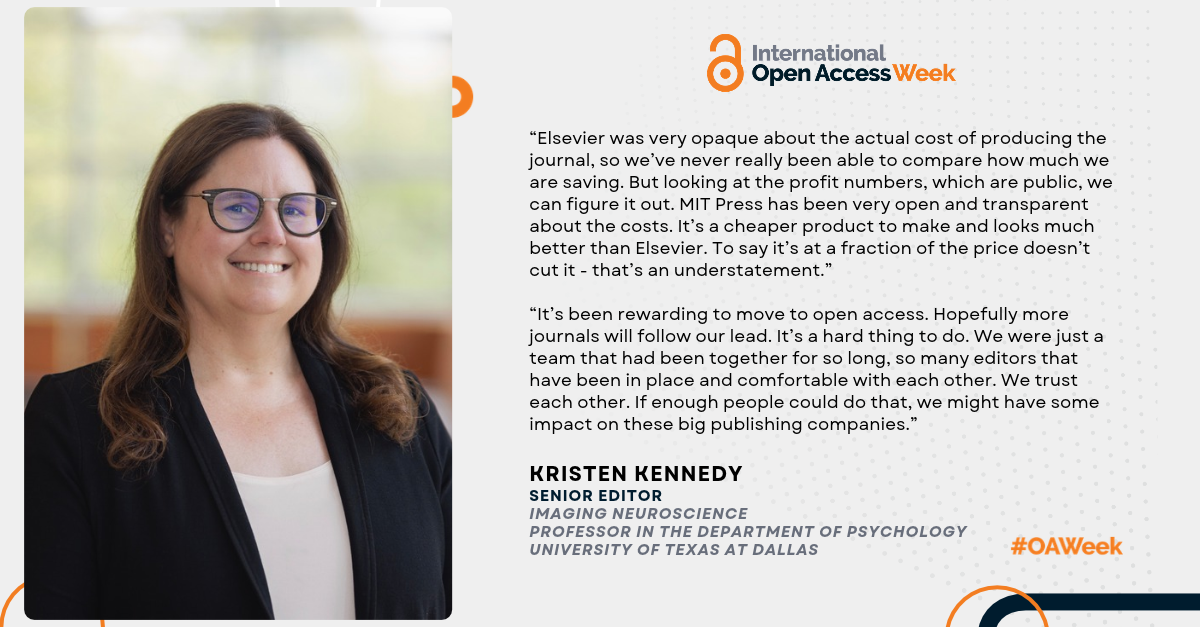
“Elsevier was very opaque about the actual cost of producing the journal, so we’ve never really been able to compare how much we are saving. But looking at the profit numbers, which are public, we can figure it out. MIT Press has been very open and transparent about the costs. It’s a cheaper product to make and looks much better than Elsevier. To say it’s at a fraction of the price doesn’t cut it - that’s an understatement.”
“It’s been rewarding to move to open access. Hopefully more journals will follow our lead. It’s a hard thing to do. We were just a team that had been together for so long, so many editors that have been in place and comfortable with each other. We trust each other. If enough people could do that, we might have some impact on these big publishing companies.”
“NIH shouldn't be paying to fund the science, publish the science, and then get access if your library doesn't carry those titles. The system shouldn't have ever become like that.”
“I'm at a decent-sized university. When I write a paper, I want to read everyone else's research and quite often I come to a paywall. I use back routes and email the author for a copy or go to a university that subscribes. The cost of knowledge shouldn't be paywalled to scientists who are just trying to fairly cite other authors. It surely shouldn't be paywalled to the general public. We want people to read peer reviewed work instead of just typing their questions into Google or AI and believing that it's reasonably correct.”
“If scientists are lazy and only cite authors whose papers they could get a hold of, it would propagate the elitist [titles] instead of citing papers that were most relevant to the topic they're writing about. If you put any barrier up, it's going to make it less desirable to try to hunt that down. It all goes under that category of cost. “
-Kristen Kennedy, Senior Editor, Imaging Neuroscience and Professor in the Department of Psychology, School of Behavioral and Brain Sciences at The University of Texas at Dallas.