Invest in Open Infrastructure
Background: Invest in Open Infrastructure (IOI) is a nonprofit initiative launched in 2019 by a coalition who believed that open infrastructure is fragile: underfunded, fragmented, and lacking long-term resilience. Since then, IOI has worked with researchers, universities, funders, policymakers, governments, and think tanks to understand the challenges they face and develop practical, strategic paths forward. Through research, advisory support, and convening, IOI brings clarity to complex decisions and helps organizations act with confidence.
Mission: IOI is a leading independent expert in sustainable, resilient open infrastructure working across the research landscape to drive change. Its mission is to help researchers, universities, funders, technology providers, and governments make decisions about the infrastructure that can lead to stronger funding, investment, and resilient systems.
The Cost of Knowledge
“At the core of our work is looking at the underlying infrastructures that help make knowledge available and help the production and stewardship of that knowledge. There are very tangible costs in terms of who can access and what support is needed to keep those systems maintained and thriving. “
“Some of our current projects are looking at what is the cost of not having access to that knowledge. If federally funded systems were to go dark, data were to be deleted, institutional memory lost, or disinvestment in collections, what does that look like? Who helps pick up that responsibility and underlying financial burden?”
“IOI came about because of an increased recognition of the need for investment in community-based solutions to support the broader knowledge ecosystem. The actual financials and business models didn't seem to be continuing apace in a way that was fruitful to allow for systems and the ongoing maintenance.”
“We're designing, piloting and working to push forward areas that are addressing some very real changes in those ecosystems due to geopolitical conditions, economic conditions. We're seeing more volatility across multiple streams of funding. We're continuing to examine innovative business models and shared structures that might allow for more resilience, cost recovery, and operational relief for those that are investing in these ecosystems to be able to sustain them. It needs to be a mix of different forms of resourcing and access to be able to provide that public good.”
“The cost component is especially pertinent right now. During the COVID pandemic, we saw what happens when those underlying systems that we rely on - government bodies providing fundamental support for public knowledge - get disrupted. That disruption across private and public philanthropies trickled down to institutions and commercial entities. Where do we find those places of innovation, so we don’t fall back into a single point of reliance and risk?”
“In the communities we represent, we're seeing the implications of those cuts that have led to infrastructures having to radically rethink their staffing structures, to radically downsize, merge, even sunset. It’s happening behind the scenes in an acutely felt way. While it might not be publicly visible, it is still pernicious.
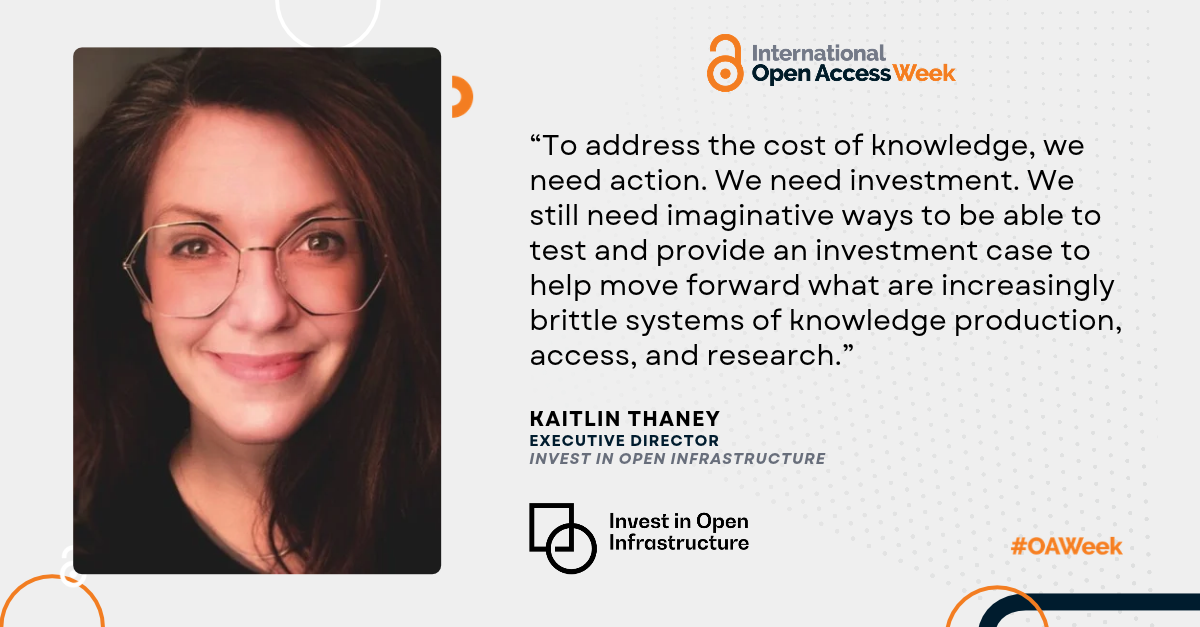
“To address the cost of knowledge, we need action. We need investment. We still need imaginative ways to be able to test and provide an investment case to help move forward what are increasingly brittle systems of knowledge production, access, and research.”
“It takes persistence, maneuverability and adaptability. When we talk about knowledge production and access and research in these broader ecosystems, there's so much complexity. It makes it a really beautiful tapestry, but allowing for multiple ways to fund those systems can be incredibly daunting.”
“IOI is dedicated to trying to both bridge the mission-driven aspect of our work and the broader service to the research community to allow for these systems to be supported. That sustainability focus and commitment to exploring business models are baked into the very tangible realities of those that we're engaging with and fit the times that we're in.”
-Kaitlin Thaney, Executive Director, Invest in Open Infrastructure