Journal of Critical Public Health
Background: In July 2023, the editorial board of Critical Public Health resigned en masse from Taylor & Francis over fundamentally different perspectives around the role and process of scholarly publishing. Among other things, after years of operating as a hybrid journal, the publisher wanted to move entirely to an APC model while the board wanted to give authors without the funds to pay APCs another option.
The original editorial collective regrouped to start its own diamond open-access publication, Journal of Critical Public Health (JCPH). It has published seven issues since launching in July 2023. The new non-profit, community-owned, peer-reviewed scholarly journal welcomes submissions that take power seriously, provide innovative perspectives, have implications for policy and practice, and/or question taken-for-granted concepts in public health.
As JCPH has become more discoverable (through DOAJ, Open Journals Collective, CAB Abstracts and Global Health), the volume of submissions has increased, along with the journal’s selectivity. The most recent issue, published in September 2026, includes an Editorial, five Research Articles, and two Research & Practice Notes.
The Cost of Knowledge
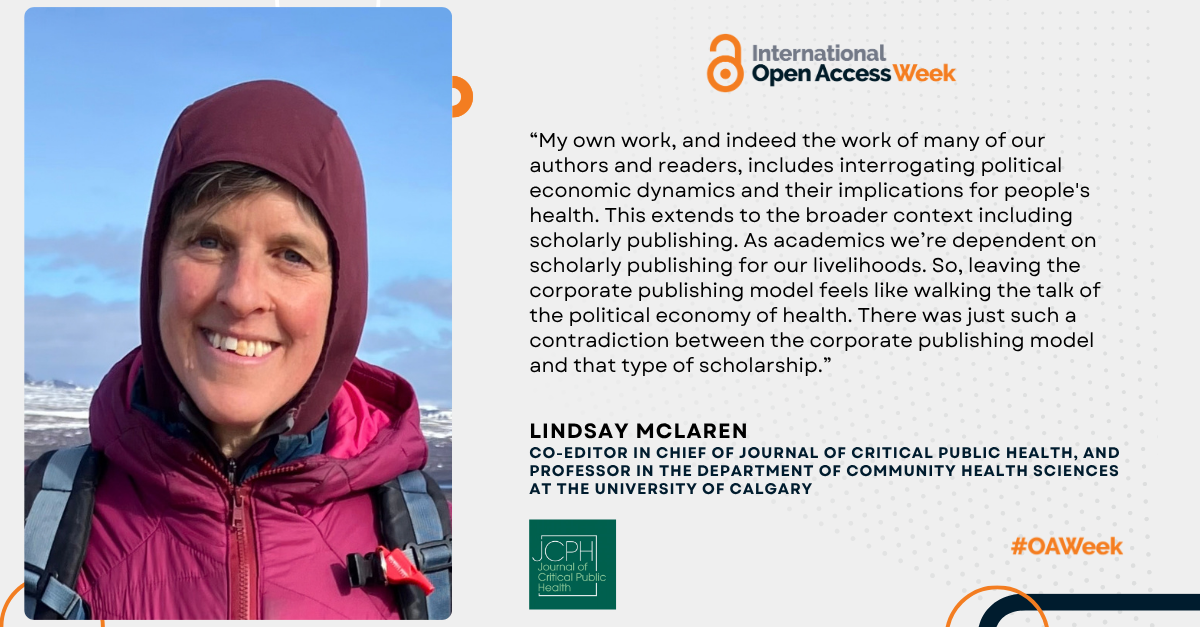
“My own work, and indeed the work of many of our authors and readers, includes interrogating political economic dynamics and their implications for people's health. This extends to the broader context including scholarly publishing. As academics we’re dependent on scholarly publishing for our livelihoods. So, leaving the corporate publishing model feels like walking the talk of the political economy of health. There was just such a contradiction between the corporate publishing model and that type of scholarship.”
“There's no question in my mind that this was the right move for us to switch to a non-profit, community-owned journal. Indeed, it was the only move to keep the integrity of our journal. We had built a reputation with our previous journal, and I feel like we've been able to uphold that.”
“The theme ‘Cost of Knowledge’ resonates – but I would add the cost and the politics of knowledge. There's obvious material inequities if you exclude authors who can't pay APCs. They are often early career authors, Global South authors, and authors working at the epistemic margins. People doing critical scholarship are more likely to be excluded - that kind of work, by definition, doesn't get the big grants because it’s critiquing institutional power.
“More broadly, the corporate publishing model is simply not compatible with the value commitments of critical scholarship. I think diamond open access community-owned nonprofit journals are absolutely the way forward.”
-Lindsay McLaren, co-editor in chief of Journal of Critical Public Health, and professor in the Department of Community Health Sciences at the University of Calgary