Knowledge Equity Lab
Background: The Knowledge Equity Lab (KEL) is an inclusive, trans-disciplinary, experimental space at the University of Toronto Scarborough established in 2020. It is a research and practice hub of projects that investigate and challenge exclusion within the structures of knowledge production and exchange. KEL serves as an umbrella for Bioline International, an open access platform for journals based in the Global South, and the Open and Collaborative Science for Development Network (OCSDNet), exploring open science as a tool for transformative development. It also houses The Knowledge G.A.P. project, the Open Praxis Forum, Community Knowledge Learning Hub, and the UNESCO Knowledge for Change Toronto Hub.
Mission - Established in 2020 at the University of Toronto Scarborough, the Knowledge Equity Lab (KEL) brings students, researchers and diverse knowledge makers together to examine and challenge inequities in how knowledge is produced, shared and valued. Its approach centers on interdisciplinarity, reciprocal relationships and community priorities, offering students opportunities to learn through collaborative research and practice. KEL’s ongoing initiatives include the Toronto Knowledge for Change Hub, building on foundational projects such as Bioline International and the Open and Collaborative Science for Development Network (OCSDNet). Its podcast, Unsettling Knowledge Inequities, developed with SPARC, explores the power dynamics shaping whose knowledge counts. Across these activities, KEL works to strengthen community-led knowledge infrastructure and create more equitable relationships within and beyond the university. It has recently expanded its work to explore the impact of AI on education and community governance.
The Cost of Knowledge
“Our lab’s focus is knowledge equity - who gets to contribute to knowledge, who has access to knowledge, who actually benefits, and who are marginalized in the system. The term ‘cost’ itself means many different things. We question the conventional understanding of cost based on monetary values - economic input and output. With APCs, there's a lot of preoccupation with the high cost of publication. We're interested in more of the social reproductive side of knowledge. “
“There's a lot of invisible work that goes on to enable knowledge production - maintaining the sense of communities, building relationships over time, cultivating each other's trust, and mentoring new people to the system and ensuring that their ideas have a voice in the broader system. These all involve a lot of work that is not calculated in the overall cost of knowledge. There's a lot of infrastructural work that is necessary, but it is not being recognized as legitimate sources of cost at the moment.”
“In order for us to have an equitable system of knowledge, views and production, we need to pay attention to maintaining those infrastructural relationships, building communities so that they're resilient.”
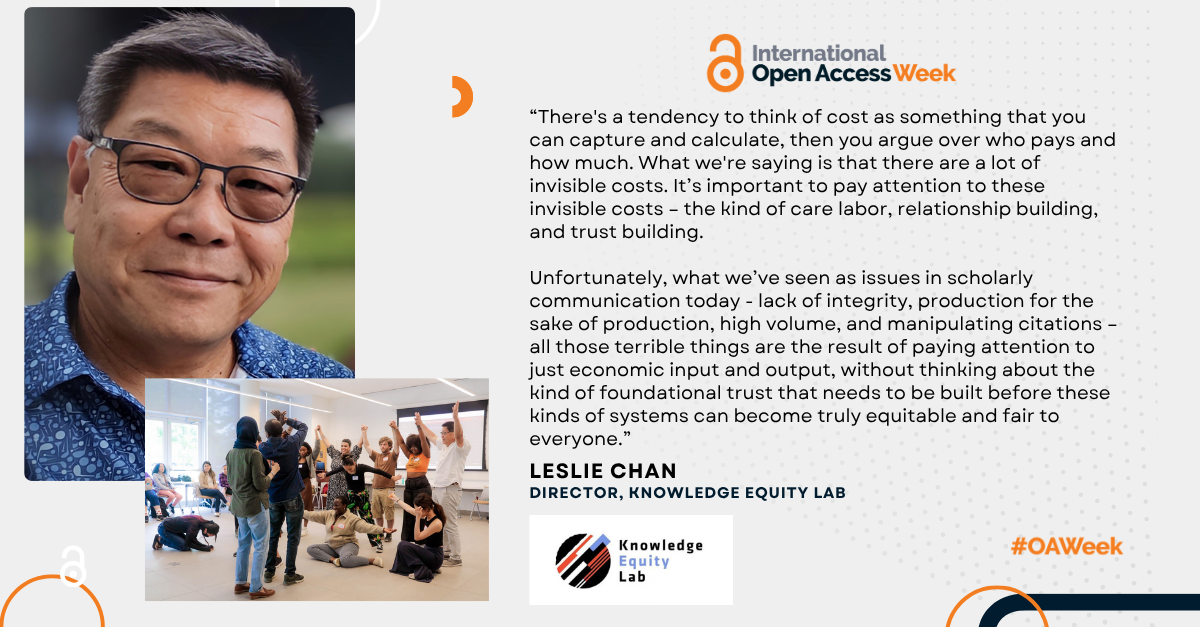
“There's a tendency to think of cost as something that you can capture and calculate, then you argue over who pays and how much. What we're saying is that there are a lot of invisible costs. It’s important to pay attention to these invisible costs – the kind of care labor, relationship building, and trust building.
“Unfortunately, what we’ve seen as issues in scholarly communication today - lack of integrity, production for the sake of production, high volume, and manipulating citations – all those terrible things are the result of paying attention to just economic input and output, without thinking about the kind of foundational trust that needs to be built before these kinds of systems can become truly equitable and fair to everyone.”
“Journals have become more like profit centers and accounting centers rather than communities where we build trust and relationship on which knowledge and knowledge equities depend. Those invisible costs and the cost of exclusion of scholarship are being ignored because the current system focuses on the high volume output and targeted high reputation journals. The system now makes a lot of important scholarship and knowledge invisible.
“There is a very high cost that we are actually paying. We are all poorer as a result of not being able to really enjoy the richness of this kind of knowledge system.”
-Leslie Chan, Director, Knowledge Equity Lab